

Forest honey is a natural product that is elaborated in the stomach of honeybees from nectar of flowers from mountains and secretions of trees of the forest typical to the region. A honey that is slightly sweet and very rich in minerals, which you will love!

Best selection of forest honey of the highest quality from Spanish beekeepers.
Index:
|
Summary: Forest honey is a honey with a powerful flavour and very rich in minerals. All our honeys come from Spanish beekeepers committed to quality. It is also available in our shop in Las Rozas de Madrid.
Related articles: Raw unpasteurised honey. The 5 best honeys of Spain.
Firstly, we show you the most important characteristics of honey of the forest:
This honey has a dark color, almost black when the honey is liquid. When crystallized, it acquires brown or greyish brown shades.
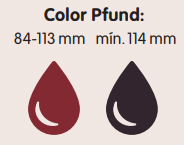
Photo 1: Forest honey colours
The aroma of this forest honey is very intense and persistent, especially in the retronasal, and reminds the deciduous forests in autumn, humus and mushrooms with light touches of liquorice and mint. Furthermore, On the palate, it reveals salty undertones and distinct bitter notes, whose intensity may vary depending on the origin of the honeydews.
Video 1: Forests of Spain
In this video, you’ll discover the breathtaking Spanish forests where our exquisite forest and mountain honeys are carefully harvested.
Harvested at the height of late summer—mainly in August and September—this honey is collected when plants produce their richest flow of honeydew, resulting in a product full of character and complexity
In order for it to be forest honey, there must be no or very little cultivated pollen. Pollen of Fabaceae, Cistaceae, some labiatae, often heather and bramble are also present. In humid areas the presence of DEH (algae and fungi, honeydew elements); in dry areas these DEH disappear.
At the moment, we do not have any beekeepers supplying us with organic forest honey. Therefore, our current selection features only conventional forest honey—crafted with care, though not certified organic.

Photo 1: Honey Sierra de Montoro
In addition, Honey is a pure gift from nature—harvested with care, without causing harm to any living being.
What’s more, these exceptional honeys come from dedicated beekeepers who help sustain rural communities, creating jobs and generating local wealth. Our shop was founded with the same purpose: to support and promote the vitality of the Spanish countryside
Forest honey provides many health benefits. Its benefits, like other quality honey, are due to two reasons. Firstly, honey has a very low water concentration, and also has enzymes. Secondly, honey has many components from forest flowers and tree mielatos.
Honeydews, in particular, are rich in minerals—something that can be scientifically measured by their high electrical conductivity. These minerals, such as iron, contribute positively to our health, each playing an essential role in supporting the body’s functions.
Drawing from the knowledge of doctors, experienced beekeepers, and traditional wisdom, we’ve identified compelling scientific evidence supporting these claims. One such study, published in a respected Chinese journal of chemical and pharmaceutical research, was authored by scientists Satarupa and Subha. It details the many positive effects attributed to forest honey, helping us better understand the power of this natural treasure.
Please note: These benefits are based on traditional knowledge, the experience of beekeepers, and cultural practices. While honey is a natural product with remarkable qualities, it is not classified as a medicine, and its health effects should not be considered as medical claims..
The high electrical conductivity of this honey indicates its richness in minerals, particularly iron—an essential nutrient for individuals suffering from anemia.
In summary, we want to highlight that these insights come from a combination of traditional experience, popular knowledge, and scientific research. However, if you have any health concerns, we strongly recommend consulting your doctor.
People suffering from allergies should be careful when using this honey for the first time. Also, this natural product should not be abused, especially by people seeking to lose weight.
Also, people with pollen allergy should be careful with its consumption. In this case, ask your doctor.
Forest honey, like dark honey, is a less sweet honey than the rest, so it is ideal for people looking for more powerful flavors and less sweet.
Delicious on toasts, biscuits, coffee and tea. Furthermore, in the preparation of dishes, this type of honey is recommended for making and pairing cold creams, red fruit sauces and chocolate desserts. Likewise, it is also ideal to combine with spicy dishes.
The crystallization of raw forest honey is usually very slow, and once crystallized can have both fine and coarse crystallization. As a result, it is one of the honeys that will almost always remain liquid.
In addition, the food sources that a forest provides for bees are not the same throughout the year. Certainly, each forest is not the same in Spain and the rest of Europe, so we will find noticeable differences each year of this type of honey and in each geographical origin.
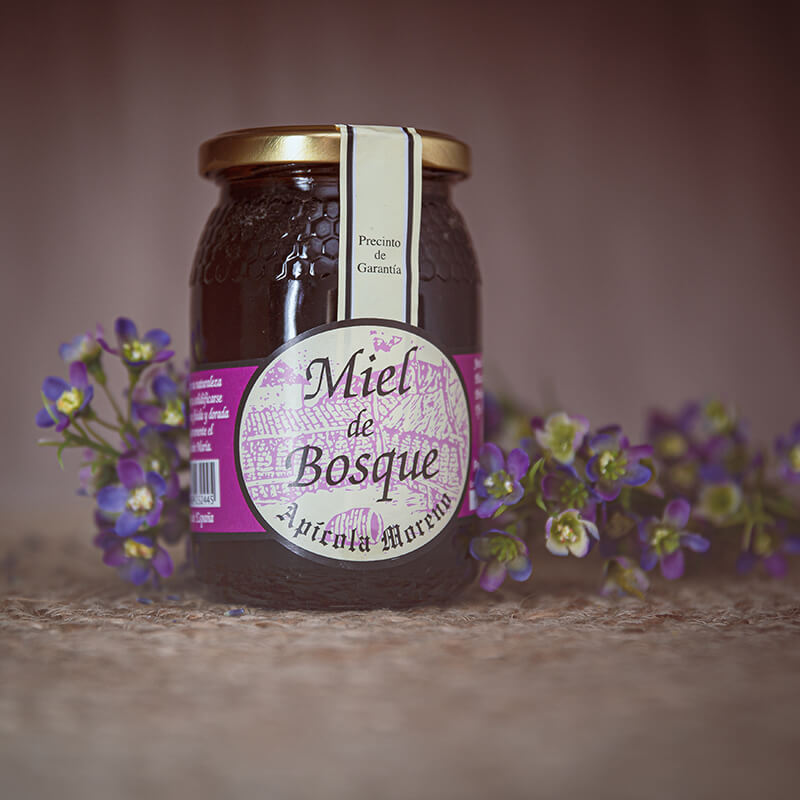
Photo 3: Forest honey of Apícola Moreno
Furthermore, you should not feed honey to infants under 1 year olf. In this case, it is recommended that you ask your doctor for advice.
This honey comes from a diverse mix of floral and tree sources native to Spain’s forests and mountains. Predominantly, it includes heather, holm oak, and oak blossoms, complemented by subtle notes of rosemary, thyme, and blackberry.
We proudly obtain our raw honey from two passionate beekeepers who carefully tend their hives
Beekeeper |
Location |
Characteristics |
| Apícola Moreno | Brihuega, Guadalajara | No organic |
| Adelheid | Germany | No organic |
| Las Obreras de Aliste | Zamora | No organic |
Table 1: Different beekeepers we work with.
In short, the origin of forest honey can vary quite a bit from one year to the next, because our beekeepers can place the hives in different parts of the forest. There can also be significant variations in flora throughout the year.
Additionally, here are some of the questions we’re most often asked:
This is one of the honeys that takes longer to crystallise, so it will probably be liquid.
However, this honey is rich in minerals and has a positive effect on people suffering from anaemia.
Other honeys similar to forest honey are mountain, heather, oak and chestnut honey.
In Spain, there is usually little difference between the two honeys.
Finally, we indicate the chemical and physical parameters that a forest honey must pass.
Chemical parameters |
||
| Colour (mm Pfund) Maximum 90 | Humidity (%). Max. 18 | Fructose + glucose: Minimum 45 |
| Sucrose: Maximum 5 | Electrical conductivity (mS/cm): minimum 0.7 to 0.9 | Free acidity (meq/kg): Maximum 50 |
| HMF (mg/Kg = ppm): Maximum 40 | Diastasases (Schade Units): Minimum 8 | Special parameters (F/G index): Minimum 1.5 |
Table 2: Directive 110/2001 EC, RD 1049/2003 in Spain
Source:
Fundación del corazón https://fundaciondelcorazon.com/