


Bees play a fundamental role on this planet. We have been coexisting with them for millennia. Here, we want to highlight the crucial role these insects play in our lives. Additionally, we’ll share some interesting stories from our long history of coexistence. Moreover, let’s not forget about the fantastic delicacy of their honey.
Index:
|
Summary: The pollinitation, a very important process done by bees and other animals. Also, you will discover some curious facts about bees, honey and other curiosities. You can also find a fantastic selection of Spanish honeys in our shop in Las Rozas de Madrid: orange blossom, eucalyptus, arbutus, thyme…
Other interesting articles: Where to buy quality honey?
One-third of the plant foods consumed globally are pollinated by honeybees. They pollinate about 400 cultivated species and over 80% of plants grown for food. Bees and other pollinators are essential to the health of the earth’s natural ecosystem because they not only pollinate our agricultural crops but also wild flowers.
In terms of money, bees are thought to be worth $170 billion to the world economy annually. This ignores the essential role they play in maintaining the earth’s ecosystem.
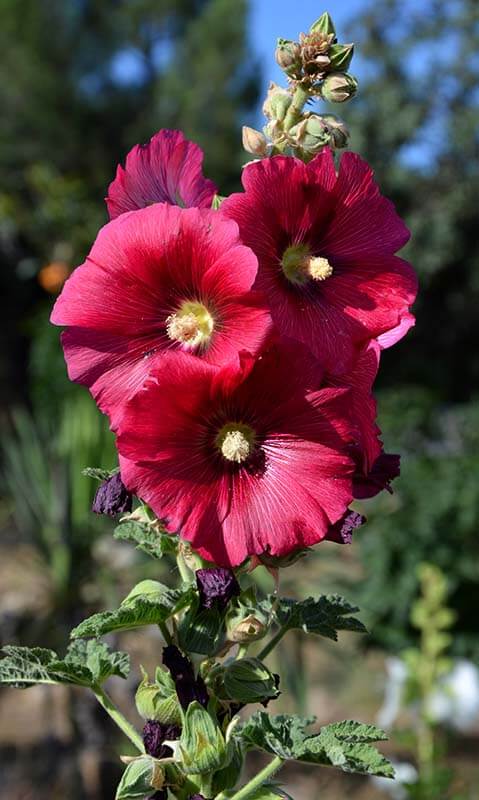
Photo 1: Flowers of the red royal mallow
With their ability to pollinate nearly 90% of the world’s wild flora, bees are essential to the upkeep of the global ecosystem. A vast array of birds and mammals on Earth are fed by the seeds, fruits, and wild fruits produced when flora is pollinated. As a result, bees are vital to both species diversity and the chain of life.
In Europe, there are roughly 2,000 different species of wild bees, but only 2% of them are able to pollinate 80% of the crops that need to be. The majority of bee species live alone and many are specialized to pollinate a single kind of plant. Because their life cycle is in sync with the plant’s, they feed their brood and pollinate the plant while it is in bloom.
According to Greenpeace, the loss of bees and other pollinating insects is putting 70% of Spain’s agricultural crops at risk. Fruits, vegetables and fruit so common in our greengrocers’ shops, such as: kiwis, pumpkins, melons, watermelons, courgettes, apples, peaches, lemons, almonds, etc. could disappear. Also, crops dedicated to livestock feed. In addition, non-edible crops such as cotton would also be at serious risk.
egarding the potential disappearance of bees, it is common to come across the doomsday prophecy credited to Albert Einstein. It reads, “If bees were to disappear from the face of the earth, man would only have four years left to live on Earth,” despite the lack of concrete evidence to support its authorship. In its original language, German (Wenn die Bienen verschwinden, hat der Mensch nur noch vier Jahren zu leben).
Even so, given human ingenuity, four years is a bit much. However, this mention emphasizes how closely beekeeping has been linked to human survival.
Humans began using bees’ labor over 20,000 years ago. The paintings found in those caves serve as evidence for this. They demonstrate how people harvested honey from beehives. In order to pollinate their crops, Egyptians also traveled across the Nile with their hives. They also buried their pharaohs with honey-filled containers so the pharaohs could carry the honey into the afterlife.
Conquistadors brought their honeybees to America in the fifteenth century, where they were used for agricultural purposes. America was already home to wild bees, but not Apis mellifera. Honeybees were transported from America to Australia and Asia, but they did not exist there either.
Other insect pollinators of flowers are bumblebees. Although bumblebees are able to pollinate more flowers in a shorter time, bumblebee colonies are much smaller than those of honeybees. A bee colony (hive) usually consists of about 50 000 bees. In comparison, a bumble bee colony usually consists of about 250 bees. Therefore, honey bees are the best insects for pollinating plants.
It should also be noted that pollination of flowers by bumblebees is poorer. For this reason, farmers always want to use bees to pollinate their crops.
In addition, honeybees provide us with honey, propolis, royal jelly and wax.
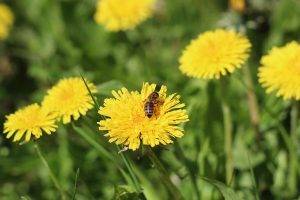
The great task performed by bees is the pollination of most of the world’s flowers. A simple task that millions and millions of bees do every day, and which is fundamental. A task that only pecorator bees carry out and which requires them to travel for miles.
In order to learn more about this beautiful process, we leave you a video. Here you can see how a bee collects nectar and pollinates. A simple, meticulous and very beautiful task as you can see.
Finally, among the historical facts worth mentioning, we have the following:
In the field of warfare, many peoples have used bees either as a weapon of defense or attack. One example of this dates back to the first century BC in the Roman Empire during a campaign led by Pompey against the Heptakometes in Asia Minor. In this instance, bees were not employed directly, but rather their honey.
As Roman troops under Pompey traversed narrow mountain passes, they encountered pieces of honeycomb with honey. The soldiers, as was their custom, gathered and added these to their daily food rations. However, shortly after consuming the honey, they experienced delirium, severe vomiting, and other illnesses. In this compromised state, the Roman army was easily defeated by the defenders of Heptakomete, who knew that this honey acted as a poison.
Locals in this region of Asia were aware that honey produced during certain times of the year could be toxic to humans. This honey came from plants like Rhododendron ponticum and azalea, which contain alkaloids toxic to humans but harmless to bees. Beekeepers in this area of Turkey are mindful of these toxic plant bloomings and selectively remove toxic honey to prevent harm to the bees when they have little food.
Sources:
The newspaper The Guardian: http://www.theguardian.com/