
A fantastic idea is to build drinking troughs for bees and other insects to help their survival. Therefore, our garden is a fantastic place to place these containers and in this way, we will collaborate with these insects that produce delicious honey. It is not only necessary to build them, we also need to have some guidelines to know where to place them and take care of them. All this necessary information, which will do so much good for the insects around you, will be explained here. Moreover, as you will see, it is much easier than you think and you will be able to build it with many recycled materials. So, a way to contribute to a more sustainable world.
Index:
|
Summary: A fantastic idea to help bees is to place drinkers for bees and other insects in your garden. Consequently, you will help the survival of the bees that produce the much desired honey. Moreover, in our shop in Las Rozas de Madrid you have at your disposal a fantastic selection of raw multi-flower and single-flower honeys.
Other studies: Where to buy quality raw honey?
Bees and other insects need water like any other living thing to survive. In the case of bees, they drink water to quench their own thirst and also store it in their stomachs to carry it to the rest of the hive.
Water in the hive can have several uses, the first being to quench the thirst of the bees in the hive. The second use is to regulate the temperature of the hive. To do this, they pour the water over the hive and by the evaporation of the water, heat would be expelled and the temperature would be lowered. Consequently, they cool the environment and lower the temperature.
It can also happen that the honey in the honeycomb cells loses a lot of water and becomes very dry. The bees add a little water to it and increase its humidity. This makes it more edible and palatable.
Although bees are able to obtain water on their own, in many cases, the sources they find in nature are not of high quality. In many cases, the water is obtained from swimming pools, irrigation systems, rivers and other water sources. Water that in many cases is not drinkable because it contains chlorine, pesticides or other pollutants. For this reason, supplying clean, quality water is essential for bees and for them to produce quality honey.
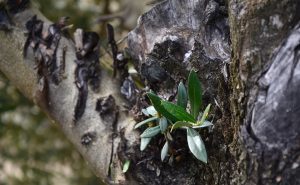
Photo 1: Eucalyptus trees in Galicia
When choosing the watering trough for the bees, we must always put clean water in a safe area. Also, we have to take into account the following key points so that the bees are at ease and do not have any problems.
When using a drinking trough we must pay attention to how much water we put in and how we put it in, as we can cause the bees to drown. To avoid this, we should place landing strips such as stones, gravel, sticks or other utensils. If the bees slip and fall into a large body of water where they cannot hold on, they will drown.
In the case of bees, they can swim for a period of time but if they do not find solid ground, they will eventually exhaust themselves and drown.
According to some research, water with certain odours attracts bees more than unscented water. Among the odours, they are most attracted to earthy scents. Therefore, they look for smells of damp earth, decomposition, worms, salt, aquatic plants, plant debris, moss, etc.
Consequently, you should not put water directly from the tap as this will not attract them. On the other hand, you should add a little salt and some plant debris to the water in your drinking trough. In this way, they will discover it and the rest of the bees in the hive will come for more water.
We must make sure that we place the drinking fountain in a safe place where no one will disturb or attack them. The best recommendation is to place the drinker in an area away from the garden, and hidden from possible predators such as bee-eaters. Also, placing the drinker on flowering plants will allow the bees to find it earlier and they can collect nectar to make their delicious honey.
As well as placing the waterer, it is essential to keep an eye on it so that it is always full, especially on the hottest days when the bees need water the most. Also, when we fill it with water again, it is very positive to pour water in until it overflows to remove possible mosquito eggs or other insects. There is no need to change the water because, as we have said before, it is the earthy smells that attract the bees.
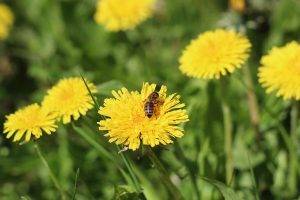
Photo 2: Bees and wildflowers
With some utensils that you may have at home you can make great drinking troughs and help bees to survive. They will also have water to make their much-loved honey.
If you have kept chickens or other birds, you can reuse their water troughs. All you have to do is keep the bottom of the drinker and put stones, plant debris or other objects that protrude from the surface of the water in the drinker. This will give the bees dry ground to perch on and prevent them from falling into the water and drowning. You are also likely to attract other insects such as butterflies that will end up in your trough in search of water.
Bees have a straw-like tongue, or proboscis, with which they can absorb liquids. With this proboscis fully extended, they can reach deep into flowers and pull out the nectar stored in them. Likewise, it can do the same with hummingbird feeders, using one of their ports and drink sugar water.
Take any household container; pots, frying pan, plate, etc. In it place a few stones of sufficient size so that they protrude from the water. Therefore, we can use any container we have at home that has the function of storing water.
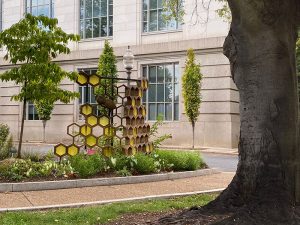
Photo 3: Bee spaces in Washington, US
Drought is a lack of rainfall that reduces the water available to bees and their food sources. A lack of rain means that plants do not flower, and if they do flower, the flowers have much less nectar. Consequently, this causes major problems for the bees, including increased disease and consumption of their own stored resources.
In order to mitigate the consequences of drought, such as the one we are experiencing in 2023, we give the following advice:
It is essential to keep drinking troughs with clean water, otherwise the bees will get sick and die. They also need it to regulate the temperature in the hive. It is therefore necessary to change the water from time to time, especially in summer. The heat and daylight hours favour the development of bacteria and other organisms that contaminate the water.
Having larger bee populations will only increase the problem of water scarcity. However, it is necessary to maintain a balance between dying bees and new hatchlings in order to maintain the health of the hive.
Therefore, this is a decision to be made by the beekeeper according to the weather forecast, the characteristics of the site and his experience.
Supplementary feed should be ready in case the bees run out of food. A severe drought would also kill the flowers and other plant food.
By keeping 10 combs in the brood chamber in Langstroth hives, the bees will regulate the temperature more efficiently. With fewer combs, the bees ensure less food for the hatching bees. Consequently, this will cause them more stress as they will not have enough food.
Avoid placing too many hives in one area. If there may already be too little food for some hives, they will have less food if the number of hives is greater.
In short, all these measures will help you to mitigate the effects of droughts. Especially in these years when we are suffering an unprecedented drought. Likewise, the beekeeper’s experience and taking measures in advance are fundamental in these critical cases.
When it rains, bees’ wings get wet, and flying becomes much more difficult. Also, if a bee gets a large drop of rain, it can break one of its wings. However, the big problem is that the bee’s body absorbs the water and it becomes much heavier. Consequently, the bee has to exert much more physical effort to fly, causing it to end up on the ground. Eventually, she becomes exhausted, her body temperature drops and she no longer has the energy to return.
A similar process happens when the bee falls on the surface of water. The bee eventually dies from exhaustion. Because it does not have enough energy to reach the shore and get out of the water.
All in all, fantastic ideas to help bees in these decades of fighting for their survival. In addition, these are basic tips to carry out in times of severe drought.
Source:
Drinking troughs for bees. Ecoinventions
Etiquetas: Miel cruda · Guías · Apicultura
Compartir: Facebook · Instagram · Correo